Skip to Main Content

Fine Arts

Fine Arts Sandbox

Welcome

Welcome! This guide will introduce you to library resources and services that will assist you as you complete the research paper assignment.

Contact a librarian at cud-ref@luc.edu for research help, book requests, or library service questions. I'm here to help you succeed in your research, and am happy to meet with you to discuss your work and recommend:

8 x 10’’ is equivalent to 20.32 x 25.4 cm

Searching the Catalog

The library catalog is a great place to start your research. Here are some tips to make searching more effective:

  1. Make sure that you sign in. This allows you to see your access options for library materials, save searches, set notifications on saved searches, and save items to your favorites.
  2. Use Boolean operators if you're doing a keyword search. For example:
    1. Painting AND Women AND Nineteenth-century - the catalog will return only materials that mention all three search terms: painting, women, and nineteenth century
    2. Painting AND ("latin america" OR "south america") - the catalog will expand your results by returning materials that mention both painting and Latin America or materials that mention both painting and South America
    3. Painting AND "Latin America" NOT "pre-columbian" - the catalog will reduce your search results by returning materials that mention painting and Latin America but do not mention pre-columbian.
    4. Make sure that you enter Boolean operators in all caps: AND, OR, NOT
  3. Use truncation and/or wildcards. For example:
    1. Entering the search term paint* will return results for paint, paints, painter, painters, painting
    2. Entering the search term wom?n will return results for woman, women
  4. Group your terms using parenthesis to do multiple searches at once. For example:
    1. (Mayan OR Incan) AND "pre-columbian"
  5. Narrow your results to a specific genre, place, or time. For example:
    1. Surrealism AND sculpture
    2. Pop art AND Latin America
    3. (Modernism OR avant-garde) AND 20th century

How to Read Call Numbers

How To Read Call Numbers

This is an explanation of how books with Library of Congress call numbers are sorted.  This gives a better understanding of Library of Congress shelving.
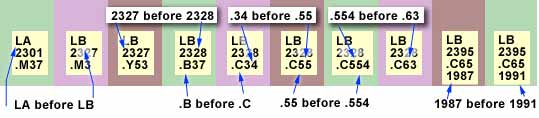
  1. The first line is always a letter line and is filed alphabetically.
  2. The second line is a whole number line and is filed numerically.
  3. Sometimes the second line has a decimal and continued on the same line or the third line.  Anytime you see a decimal point, always take each space separately.
  4. Other lines may include volume numbers, copy numbers, dates, or a combination.
  5. No dates come before a date.

Ten Library of Congress call numbers in order on a shelf. On the first line, 'LA' before 'LB'.  On the second line, '2327' before '2328'. On the combination letter number line 'B' before 'C'. For the numbers after the letter on the combination line, '.55' before '.554' and '.554' before '.63'.  For the last line, '1987' before '1991'.

Loyola uses the Library of Congress classification system; materials on art are located in Class N in the following call number ranges, if you would like to browse the stacks (second floor of Cudahy):

  • N: Visual Arts
  • NB: Sculpture
  • NC: Drawing, Design, Illustration
  • ND: Painting
  • NE: Print media
  • NX: Arts in general
  • TR: Photography