Skip to Main Content

History

Locate core research resources in history

HIST 370: Wealth & Inequality

Getting Started: Searching the Library Catalog

The library catalog is a great place to start your research. Here are some tips to make searching more effective:

  1. Make sure that you sign in. This allows you to see your access options for library materials, save searches, set notifications on saved searches, and save items to your favorites.
  2. Use Boolean operators if you're doing a keyword search. For example:
    • Gilded Age AND "income inequality" - this query will return only materials that discuss both the Gilded Age and income inequality.
    • "War on Poverty" AND (legislation OR "social programs") - the catalog will broaden your search to include materials that discuss either legislation or social programs related to the War on Poverty.
    • "labor movements" AND "20th century" NOT "Cold War" - this will reduce your search results by returning materials that discuss labor movements in the 20th century but exclude those related to the Cold War.
    • Make sure that you enter Boolean operators in all caps: AND, OR, NOT
  3. Use truncation and/or wildcards. For example:
    • Entering the search term inequal* will help you find materials on inequality, inequalities, inequitable, etc.
    • Entering the search term wom?n will return results for woman, women
  4. Group your terms using parenthesis to do multiple searches at once. For example:
    • ("voting rights" OR "voter suppression") AND "1965 Voting Rights Act"
  5. Narrow your results to a specific genre, place, or time. For example:
    • "Voting Rights Act" AND "United States" AND "1965"
    • "civil rights" AND "United States"
    • "United States" AND "presidential race" AND "20th century"

How To Read Call Numbers

This is an explanation of how books with Library of Congress call numbers are sorted.  This gives a better understanding of Library of Congress shelving.
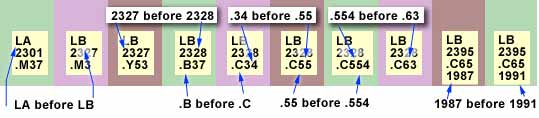
  1. The first line is always a letter line and is filed alphabetically.
  2. The second line is a whole number line and is filed numerically.
  3. Sometimes the second line has a decimal and continued on the same line or the third line.  Anytime you see a decimal point, always take each space separately.
  4. Other lines may include volume numbers, copy numbers, dates, or a combination.
  5. No dates come before a date.

Ten Library of Congress call numbers in order on a shelf. On the first line, 'LA' before 'LB'.  On the second line, '2327' before '2328'. On the combination letter number line 'B' before 'C'. For the numbers after the letter on the combination line, '.55' before '.554' and '.554' before '.63'.  For the last line, '1987' before '1991'.

Choosing a History Database

Select a history-focused research database using the lists linked below:

Databases by Region

Databases by Period

General Databases

Newspapers, Databases, and other Collections

Images printed in Newspapers and Periodicals, as well as other audio and video recordings.